
Swinging on T-BOW® in a Chronic Knee Injury · Benefits, regarding a case

Updated: Jul 26

by Emilio López, Expert in Sport and Fitness Training, EU
Physiotherapeutic Advice: Sandra Bonacina and Gonzalo Cámara-Navarro
-----------------
Summary
- Injury history: After a jump fall the author suffered a right knee sprain with lateral collateral strain and partial medial meniscus tear, complicated by phlebitis. Two arthroscopies (meniscal debridement) and persistent pain/edema left the author unable to run or jump for ~10 years; further surgery was avoided.
- Conventional rehab: Strengthening (vastus medialis, hamstrings), proprioception and low‑impact training improved tolerance and range but did not restore pain‑free running/jumping.
- Introduction of T‑BOW® (2008): The author purchased a T‑BOW® and began balance and swing training without pain. Progressively observed improved knee stability, more constant center of pressure, restored lower‑limb motor patterns and reduced painful compensations.
- Mechanisms of benefit:
- Narrow lateral edges demand bilateral ankle control and segmental independence.
- High reactivity and single predictable axis produce rapid, precise postural adjustments and extraordinary proprioceptive feedback.
- Lateral swings stimulate the leg’s longitudinal “screw” (spiral) dynamics, activating peroneals, hip external rotators, adductors and vastus medialis, improving closed‑chain joint stabilization.
- Cushioned rocking reduces joint impact while enabling graded difficulty from basic balances to advanced functional tasks.
- Outcomes: The author regained ability to run (up to 10 km/h) and briefly skip rope—activities not possible for over a decade—reporting notable functional recovery and reduced symptoms.
- Practical note: T‑BOW® offers adjustable, accessible balance/rehab progressions superior in reactivity and precision to softer, multi‑axis devices (BOSU, Balance Dome) and is useful across fitness levels for therapy, prevention and sport.
----------------------------------------------------------------------------------------------------------
HISTORY OF THE INJURY
After a fall due to an imbalance in a jump, I suffered a sprain to my right knee that resulted
in a mild strain of the lateral collateral ligament and a partial tear of the medial meniscus.
This was complicated by phlebitis that affected the right leg and foot. I underwent
arthroscopy to remove part of the meniscus, but the intervention was unsuccessful,
leading to a second intervention two years later due to acute pain in the knee during
jumping and maximum flexion, as well as generalized edema that caused phlebitis with any
impact activity, preventing even running short distances.
During the second arthroscopy, fragments of the torn meniscus were removed and patellar
chondropathy was diagnosed. After rehabilitation, I returned to my normal training, but
the discomfort persisted. In a new medical consultation, no negative evolution of the injury
or new pathology was evident. A repeat arthroscopy was discouraged and strengthening of
the vastus medialis was recommended to help center the patella. I continued to train
within my functional limitations, avoiding joint impacts and using light loads in pain-free
ranges of motion. I also worked on my hamstrings and performed proprioception exercises
to improve joint stability, achieving greater tolerance to load and an increase in joint range,
although I still couldn't run or jump without pain. I applied ice and anti-inflammatories in
case of inflammation. This situation continued for almost 10 years, during which I decided
not to undergo another surgery due to disappointing medical results.
EVOLUTION AND TREATMENT THROUGH BALANCING WITH T-BOW®

In 2008, I attended a presentation of the T-BOW® at my workplace. Initially, my interest
was more professional than personal, but I was impressed by the potential of the T-BOW®
and purchased one for my professional and personal use. During practice, I noticed a
progressive improvement in the stability and functional strength of my knee that I had not
achieved with cycling or other devices such as the Bosu. Balancing exercises in the frontal
and sagittal planes, especially in the frontal plane, showed a notable improvement.

I noticed that my center of pressure during exercise remained more constant, since not
feeling pain I did not need to adjust my joints. This allowed me to recover a previously
distorted lower limb extension motor pattern. I believe that the movement helped me
relax and control the opening chain of the lower limb, and that the activation of the
adductors benefited the vastus medialis by irradiation. The feeling of work in the peroneal
muscles was good, thus completing the closed chain work of the joint. I did not use
angulations beyond 60º, which reduced shear. In the sagittal plane, I performed eccentric
hamstring work.


To better understand the therapeutic benefits obtained with T-BOW® swinging, I
learned about the experiences of Sandra Bonacina (inventor of the T-BOW® and
professor of physiotherapy and fitness training at the University of Zurich) and
Gonzalo Cámara-Navarro (physiotherapist with extensive experience in athletes and
in the field of health). With this, I would highlight:
● The T-BOW® offers extraordinary reactivity, with a single imbalance axis and low
weight, enabling rapid and precise movement adjustments (*).
● This design allows for quick and fine variations in response to even small changes in
weight and movement, creating a cushioned swing that minimizes joint impact.
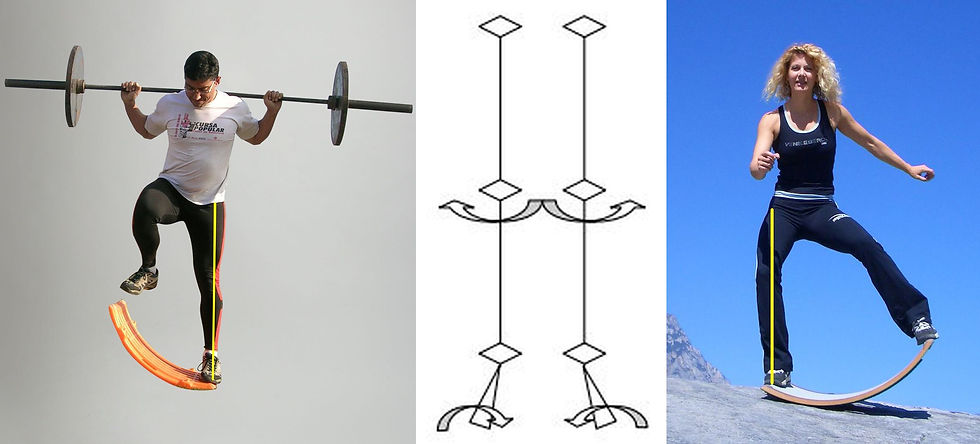
● Placing the feet on the narrow edges of the T-BOW® requires bilateral ankle control,
promoting leg verticality and excellent segmental independence.
● This setup greatly enhances the functional screwing of the leg's longitudinal axis
during lateral swings and provides deep, fine stabilization of the joints.
● The T-BOW® allows for the adjustment of difficulty levels, from basic balances to
high levels of functionality, suitable for daily activities and sports. This versatility
makes it accessible and beneficial for people of all fitness levels.

(*) Tools like the Bosu or Togu or Balance Dome of Technogym are too soft to achieve good reactivity, forcing rebalancing that is too slow and imprecise, a characteristic aggravated by its multiple axes of imbalance (half sphere), making it difficult to achieve healthy situations for the joints of many individuals.

Thanks to training with the T-BOW® and based on my personal observations, I now feel
much better and I can do two activities that I couldn't do before: running (up to 10 km/h
without discomfort) and skipping rope for a few minutes. Although these achievements
may seem modest to some, for me they represent a significant advance, since I have not
been able to perform these activities without pain for more than 10 years.

Very Quick and Precise Postural Adjustment
The T-BOW®'s curved design, reactivity, lightweight, and single axis of instability promote very quick and precise postural and coordinative adjustments.
* On concavity, convexity and narrow edges.
* In stable and unstable situations.
* Barefoot and with sport shoes; and with socks on the wooden version.
* Enhanced tactile sensitivity on the concavity of the Wood T-BOW®
* Deep joint stabilization & healthy back.
* Coordination and Balance applicable in therapy and to daily and sport activities, for all ages and levels.

Unique for Balance and Coordination on Unstable T-BOW®
Arched design, reactivity, lightweight and single axis of instability promote rapid and precise postural adjustments and responsiveness.
Many alternatives to place de feet on concavity, narrow edges and convexity (double T-BOW®).
Barefoot and with sport shoes. Also with socks on the Wood T-BOW®, which has narrower edges and its concavity has glass microspheres which extraordinarily enhances tactile sensitivity.
Balance and coordination for prophylaxis and challenges for a wide range of users, applicable to daily and sport activities.
Placing the feet on the narrow edges of the T-BOW® requires bilateral ankle control, promoting leg verticality and excellent segmental independence, also making possible a functional screw connection of the leg's longitudinal axis in spiral dynamics.
Balancing on the T-BOW® is fun and gives wellbeing (like a mother's gentle sway her baby).

Therapeutic Benefits of T-BOW® Lateral Swinging
With rapid and precise movement adjustments!!
Placing the feet on the narrow edges of the T-BOW® requires bilateral ankle control, promoting leg verticality and excellent segmental independence.
Active knee movement outward enhances the valuable training of the functional screw connection of the entire leg's longitudinal axis, in spiral dynamics, which is extremely beneficial by providing deep and fine stabilization of the foot, knee and hip joints, basis for a strong spinal foundation.




Comments