
Healthy Benefits of the Transversal Balancing on T-BOW®

Updated: Jul 26
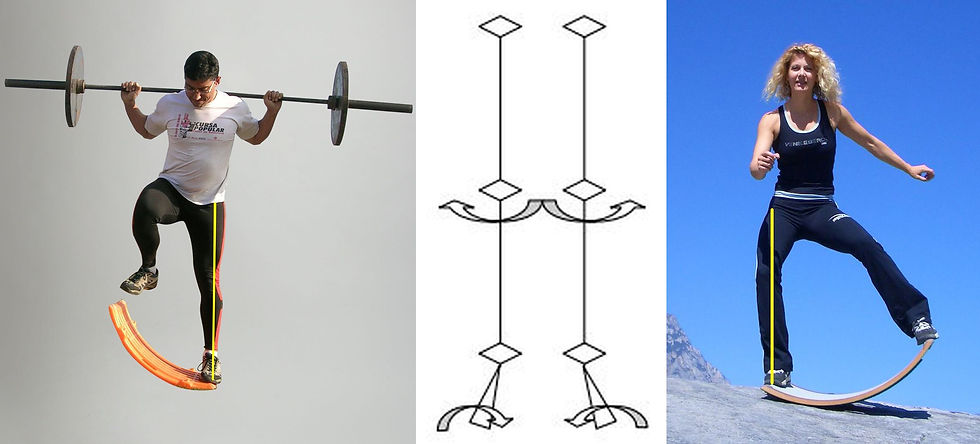
Balancing transversally on T-BOW® forces the functional twisting of the longitudinal axis of the leg!!
By Sandra Bonacina
Inventor of T-BOW® and professor of physiotherapy and fitness at Zurich University

--------------------------
SUMMARY
Balancing on the narrow edges of the T‑BOW®
- Design and effect: The T‑BOW®’s arched shape and narrow lateral edges force precise foot placement that demands bilateral control and high haptic (kinaesthetic‑tactile) sensitivity, increasing segmental independence of each leg.
- Functional mechanics: Transverse instability pushes knees inward, requiring active outward knee drive, engaging external hip rotators, sartorius, medial quadriceps and peroneals — producing a functional “screw” (spiral) action along the leg’s longitudinal axis that stabilizes foot, knee and hip and supports trunk/pelvic stability.
- Therapeutic advantages:
- High reactivity and a single predictable axis of imbalance allow rapid, fine movement adjustments with low weight and cushioned swinging.
- Narrow‑edge support enhances bilateral ankle control, leg verticality and deep joint stabilization.
- Difficulty is easily graded from basic balances to advanced sport‑specific challenges, making it suitable across fitness levels.
- Applications: physiotherapy, postural training, athletic conditioning, and health/group fitness.
---------------------------------------------------------------------------------------------
Balancing on the narrow edges of the T-BOW®
The arched design of the T-BOW® with its narrow lateral edges allows foot support that requires bilateral control of the muscles located on both sides of the foot (unlike materials with a flat surface that only require a unilateral control) and a functional connection of the longitudinal axis of the leg during swing, preferentially stimulating the haptic sensitivity (kinesthetic-tactile) involved in this support, a fact that also requires greater control and stimulation of the segmental independence of each leg.
Functional twisting of the longitudinal axis of the leg while balancing transversally on unstable T-BOW®
In balancing exercises with the transversally unstable T-BOW ®, the shape of the T-BOW® pushes the knees inwards. On the other hand, one must actively push the knees outward, which also activates the hip muscles in external rotation.
This is extremely positive and improves the stabilization of the joints of the foot, knee and hip. A good stabilization of these joints is the basis of an effective balance of the spine. The stabilized pelvis facilitates the activation of the trunk stabilizers.
Muscles activated in the functional connection of the longitudinal screwing of the leg:
The feet are preceded by the activation of the peroneos and the front musculature of the leg.
The knees rotate outward by activating the external femoral rotators and the sartorius muscle and the medial portion of the quadriceps.
As in "Spiral Dynamics", all the deep stabilizing muscles in the foot, knee and hip joints work together.

Additionally, the therapeutic benefits obtained with T-BOW® swinging, learned about the experiences of Sandra Bonacina (inventor of the T-BOW® and professor of physiotherapy and fitness training at the University of Zurich) and Gonzalo Cámara-Navarro (physiotherapist with extensive experience in athletes and in the field of health), can be highlighted as follows:
● The T-BOW® offers extraordinary reactivity, with a single imbalance axis and low
weight, enabling rapid and precise movement adjustments.
● This design allows for quick and fine variations in response to even small changes in
weight and movement, creating a cushioned swing that minimizes joint impact.
● Placing the feet on the narrow edges of the T-BOW® requires bilateral ankle control,
promoting leg verticality and excellent segmental independence.
● This setup greatly enhances the functional screwing of the leg's longitudinal axis
during lateral swings and provides deep, fine stabilization of the joints.
● The T-BOW® allows for the adjustment of difficulty levels, from basic balances to
high levels of functionality, suitable for daily activities and sports. This versatility
makes it accessible and beneficial for people of all fitness levels.
APPLICATIONS
Physiotherapy treatments.
Postural training.
Athletic and sports training.
Health and group fitness training.
VIDEO EXAMPLES OF TRANSVERSALLY BALANCING ON T-BOW®
by Sandra Bonacina · Transversally balance examples at Zurich University
by Ivan Farré-Sánchez · Group Fitness Elderly · Vectus Fitness Training


Comments